
Topics like 'Boycott China', 'Go China' and 'Go Chinese Go' have been trending on Twitter.
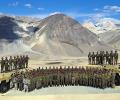
China has said that the disengagement of troops in eastern Ladakh by the Chinese and Indian armies is going on "smoothly" following a recent agreement between the two nations.

"China is an absolutely impossible factor to ignore in what has been our confrontation with Pakistan," Tharoor said.
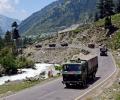
The minister said armies of the two sides do not use firearms as per provisions of two bilateral agreements sealed in 1996 and 2005.
If China is accommodating regarding Depsang and Demchok, a resolution of the Sino-India territorial dispute in Eastern Ladakh could be possible.

The meeting will take place in Chushul sector on the Indian side of Line of Actual Control.
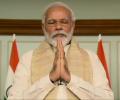
Modi said the sacrifice of Indian soldiers killed in the Galwan Valley clash in Ladakh will not go in vain.
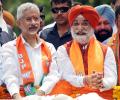
Jaishankar said diplomacy is a work of patience and India continues to discuss the issues with the Chinese side.
Chinese Ambassador Sun Weidong said India and China are able to properly manage their differences, and called upon New Delhi to avoid taking actions that may 'complicate' the situation in eastern Ladakh.

'We hope the Indian side will work with the Chinese side towards the same goal, keep up close communication through military and diplomatic channels, and ease the situation and reduce the temperature along the border'

The sources have said that patrolling will begin at these points once the disengagement that began last week is completed and both sides will move their respective troops and dismantle temporary structures.

As the military standoff between India and China drags on along the Line of Actual Control (LAC) in eastern Ladakh, Defence Minister Rajnath Singh said the talks between the two sides are going on well and indicated hope for a resolution of the lingering row.

The Indian Army has been matching up to the Chinese build up in both Pangong Tso lake and Galwan Valley, the two locations in Ladakh which have witnessed major reinforcement of troops in the last two weeks, sources said. There was very little chance of easing of tension anytime soon as both sides are aggressively holding onto their respective positions, they said.

India recently outflanked China by taking control of strategic height near Pangong lake's southern bank.
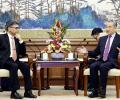
India and China have agreed to rebuild ties and resume people-to-people exchanges, including resuming direct flights and the Kailash Manasarovar Yatra this year. The two countries also discussed the resumption of dialogue mechanisms to address each other's concerns and move relations to a more stable path. The meeting comes after a period of strained relations following the Galwan Valley clashes in 2020.

India is preparing to resume the Kailash Mansarovar Yatra, a pilgrimage to Mount Kailash in Tibet, after a three-year hiatus. The decision comes as part of efforts to improve relations between India and China, which have been strained since a military standoff in 2020. The two countries have also agreed in principle to resume flight services between them.

External Affairs Minister S Jaishankar said the 2008 Mumbai terror attack marked a turning point in relations with Pakistan when Indians collectively felt that such behaviour from a neighbouring country could no longer be tolerated. Speaking at Charotar University of Science and Technology, Jaishankar acknowledged India's transformation under Prime Minister Narendra Modi over the last decade, while Pakistan has remained unchanged, continuing with what he termed as its "bad habits."
At an online media briefing, External Affairs Ministry Spokesperson Anurag Srivastava gave a run down of the events along the LAC in the eastern Ladakh region and held China responsible for the Galwan Valley clashes off June 15.

India and China have held their first diplomatic talks since withdrawing troops from two face-off points in eastern Ladakh, reflecting on the lessons learned from the border row to prevent future incidents. The two sides agreed to maintain peace and tranquillity in border areas, prepare for the next meeting of Special Representatives on the boundary question, and highlighted the importance of regular exchanges and contacts at diplomatic and military levels. The talks come after the completion of the disengagement process from the last two friction points, following an agreement finalized in October 2022.
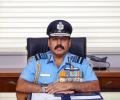
Air Chief Marshal Bhadauria was at the Leh IAF base on Wednesday where he reviewed operational preparedness of the force in effectively guarding the sensitive border areas in eastern Ladakh where Indian and Chinese armies have been on a nearly six-week standoff.

Out of 18, four personnel were critically injured but they are responding to treatment and are stable now, people familiar with the matter said.

'The sacrifice of their lives and the sacrifice of their families will always leave a void.'
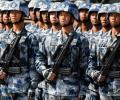
The international community must be clear that such a behaviour is unacceptable, a top US senator said.

Union minister Kiren Rijiju on Friday said he interacted with soldiers of China's People's Liberation Army along the Sino-Indian border near Tawang during a visit to an Indian Army post on Diwali.

The exchange took place at five Border Personnel Meeting points along the LAC, the sources added.
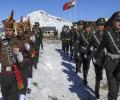
Responding to Conservative Party MP Flick Drummond on the implications for British interests of a dispute between a 'Commonwealth member and the world's largest democracy on the one side, and a state that challenges our notion of democracy on the other,' he described the escalation in eastern Ladakh as "a very serious and worrying situation", which the UK is "monitoring closely".

Xu, 60, is expected to travel to New Delhi soon to take over his new posting.

The visit is also aimed at boosting morale of the army personnel engaged in the seven-week bitter border faceoff with the Chinese troops in the region, sources added.
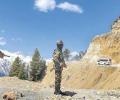
This is the third round of Corps Commander-level talks being held. The first two rounds had taken place in Moldo on the Chinese side of the LAC.

The Chief of the Army Staff interacted with almost all the injured soldiers and complimented them for their bravery.
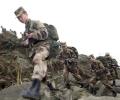
The Indian Army has been slow to react. Indian troops have deployed in the vicinity of PLA incursions, but there are no attempts to outflank Chinese positions.

The summit is also being attended by Pakistan Prime Minister Shehbaz Sharif, Iranian President Ebrahim Raisi and leaders of several central Asian countries.

Defence Minister Rajnath Singh held two-back-to-back meetings with top military brass on Tuesday deliberating on the situation in eastern Ladakh after an Indian Army officer and two soldiers were killed in a violent clash with Chinese troops in Galwan Valley.

Relations between India and China have been in an 'abnormal state' since the 2020 Galwan clash and it is a 'possibly longer than medium-term issue', External Affairs Minister S Jaishankar said in New York.

Army chief General Naravane said the ongoing dialogue will sort out all the perceived differences between the two countries.

"I am not aware of the information you provided," Chinese foreign ministry spokesman Zhao Lijian said in Beijing when asked about the reports of the Indian casualties at the contested borders. "Our border troops had a high-level meeting and reached important consensus on easing the border situation but astonishingly, on June 15, the Indian troops seriously violated our consensus and twice crossed the border line for illegal activities and provoked and attacked Chinese personnel which led to serious physical conflict between the two sides and China has lodged strong protest and representation with the Indian side," Zhao said.
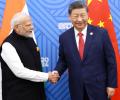
Chinese President Xi Jinping on Wednesday pledged to strengthen the strategic relationships with neighbouring countries by 'appropriately' managing differences and enhancing supply chain ties as China's tariff war with the United States escalated.
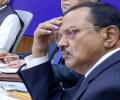
National Security Advisor Ajit Doval arrived in Beijing on Tuesday to take part in the India-China Special Representatives' talks to be held on Wednesday aimed at restoring the bilateral ties stalled for over four years' due to the military standoff in eastern Ladakh.

French Ambassador to New Delhi, Emmanuel Lenain, also conveyed condolences to India, over the death of the soldiers.
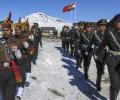
The decision to disengage the forces, locked in a bitter standoff for the last six weeks in eastern Ladakh, was taken at a nearly 11-hour-long meeting between senior Indian and Chinese commanders in Moldo on the Chinese side of the Line of Actual Control (LAC) on Monday.
